



Views: 0 Author: Site Editor Publish Time: 2026-07-01 Origin: Site


Scaling bakery production demands rigid ingredient standardization across every product line. Minor fluctuations in raw materials easily derail batch consistency. They can drastically alter leavening chemistry during baking. This unpredictability ultimately threatens your profit margins and brand reputation. Transitioning from consumer-scale ingredients to bulk sourcing requires a massive strategic shift. You must move far beyond basic taste tests. Procurement teams need to evaluate precise technical specifications and long-term supply chain stability. Assessing facility compliance also becomes absolutely critical for industrial operations.
This guide provides a definitive framework for evaluating technical specifications. You will learn how to vet a reliable cocoa powder supplier for bakery production effectively. We cover everything from essential quality control checks to logistical reliability. You will discover proven methods for securing consistent and compliant ingredient scaling. Following these actionable steps ensures your commercial bakery thrives securely in a highly competitive global market.
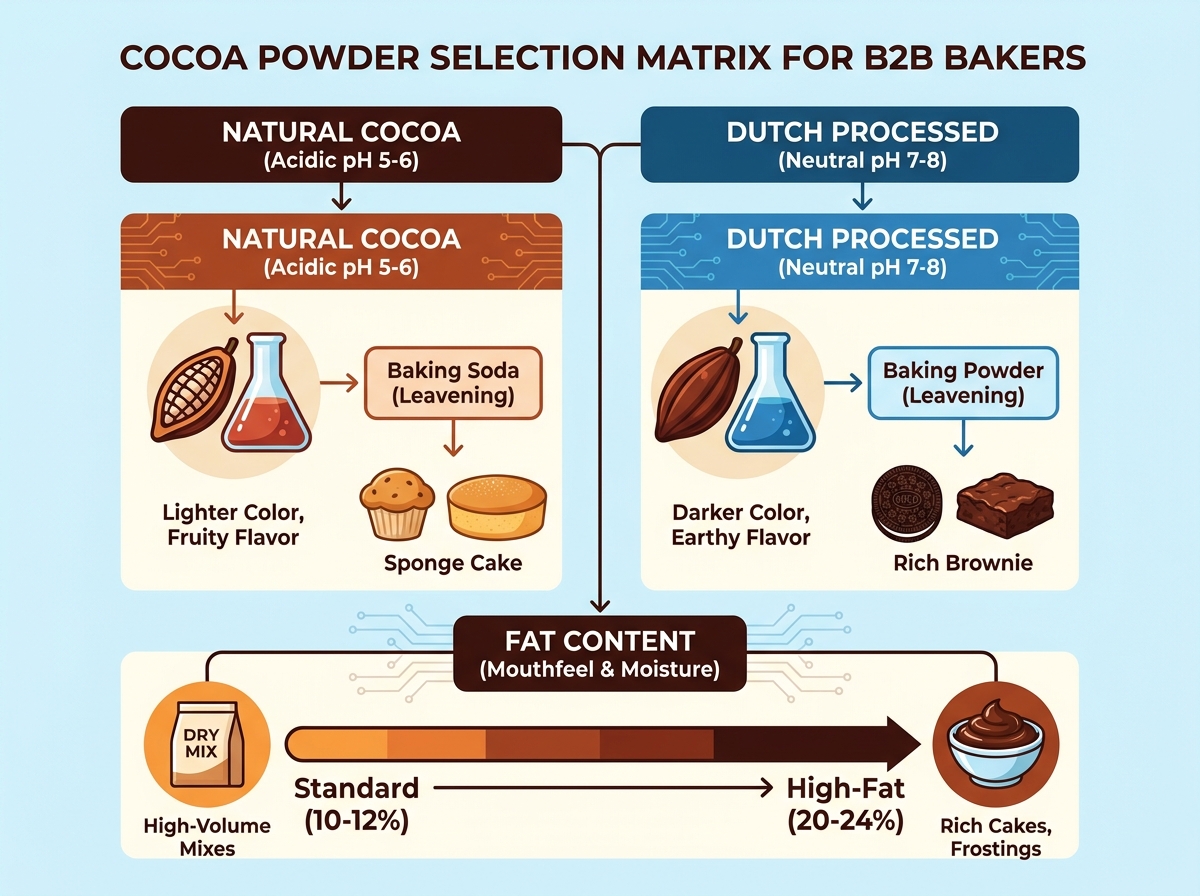
Selection must be driven by pH levels and fat content, as these dictate leavening reactions and moisture retention in commercial formulations.
Batch-to-batch consistency is critical; always require a Certificate of Analysis (CoA) to verify moisture, fineness, and color standard compliance.
A viable supplier must align with your production scalability, offering transparent MOQs, lead times, and recognized food safety certifications (e.g., SQF, BRC).
Industrial baking relies heavily on precise chemical reactions. Ingredient mismatches inevitably lead to expensive product failures. You cannot afford to swap powders without recalculating your entire recipe. Different processing methods alter the fundamental chemistry of the ingredient.
Understanding acidity levels is your first technical hurdle. Natural variations maintain their original acidic profile. They typically measure between pH 5 and 6. This acidity reacts powerfully when combined alongside baking soda. It provides excellent lift for sponges and creates a brighter, fruitier flavor profile.
Alkalized versions undergo a completely different treatment. Processors wash the nibs in an alkaline solution. This neutralizes the acidity, pushing the pH up to 7 or 8. We commonly refer to this as dutch processed cocoa powder. It requires baking powder for lift instead of baking soda. Dutching delivers much darker colors and robust, earthy flavor notes. Commercial bakers standardly use it for products resembling Oreos or intense dark chocolate cakes.
Specification Feature | Natural Processed | Dutch Processed (Alkalized) |
|---|---|---|
pH Level | 5.0 - 6.0 (Acidic) | 7.0 - 8.0 (Neutral/Alkaline) |
Required Leavening | Baking Soda | Baking Powder |
Color Profile | Light reddish-brown | Deep brown to nearly black |
Flavor Profile | Fruity, sharp, acidic | Smooth, earthy, mellow |
Fat content directly dictates crumb structure and moisture retention. Standard powders usually contain 10-12% cocoa butter. They remain highly cost-effective for high-volume dry mixes. Standard sponges also benefit from this lower fat percentage.
However, rich applications require an entirely different specification. You must source premium baking cocoa featuring 20-24% fat. This higher fat content acts as a tenderizer. It coats flour proteins and inhibits tough gluten formation. High-fat formulations are absolutely critical for dense brownies, premium layer cakes, and smooth frostings. They drastically improve mouthfeel and extend the shelf life of the final baked good.
Particle size represents a frequently overlooked technical specification. Industrial mixers operate under high shear. Coarse particles stubbornly resist hydration during mixing. They form dry clumps inside the batter. You must demand standard micron sizes from your vendor. The industry standard requires 99% of the product to pass successfully through a 200-mesh sieve. Finer particles ensure rapid, homogeneous dispersion across large batch volumes.
Securing a golden sample means very little for commercial bakeries. You need guaranteed uniformity across metric tons of raw material. Evaluating batch consistency requires stringent analytical protocols. You must understand how to read technical documentation effectively.
Every single bulk shipment must arrive carrying a Certificate of Analysis. The CoA acts as your primary quality defense mechanism. Buyers should look strictly for tight tolerances across several metrics. You should verify these data points immediately upon receiving shipments:
Moisture Content: Must remain below 5%. Higher moisture invites rapid mold growth. It also causes severe clumping during warehouse storage.
pH Variance: Must stay within a 0.2 margin of your target. Wider swings will ruin your leavening ratios.
Fat Content: Confirm it matches your contracted 10-12% or 20-24% specification.
Visual brand identity holds massive importance for baked goods. Consumers expect your chocolate muffins to look identical every time. Commercial suppliers utilize advanced spectrophotometers for quality assurance. They measure exact color matching using the Hunter L, a, b color scale. This technology maps red, brown, or black spectrums numerically. It guarantees your dark chocolate cookies maintain their signature hue year-round.
Agricultural commodities carry inherent microbiological risks. Securing safe food grade cocoa requires rigorous pathogen testing. Your supplier must document their microbial thresholds. Acceptable standard limits mandate zero presence of Salmonella or E. coli. They also place strict maximum limits on overall yeast and mold counts. Proper roasting and alkalization processes usually destroy these pathogens. However, post-processing cross-contamination remains a serious risk in poorly managed facilities.
Common mistakes occur when buyers assume all industrial cocoa ingredients undergo equal sterilization. Always demand explicit microbial testing results for every specific lot number.
Mitigating brand risk requires thorough supplier compliance verification. You cannot rely on trust alone. Authoritative frameworks and third-party audits provide necessary operational transparency. They protect your bakery from devastating product recalls.
You must establish non-negotiable credential requirements for all vendors. Your partners need recognized Global Food Safety Initiative (GFSI) benchmarks. Look specifically for SQF (Safe Quality Food) or BRC (British Retail Consortium) certifications. If operating within the United States, suppliers must demonstrate strict FSMA-compliant preventive controls. These audits verify they maintain adequate sanitation protocols and hazard analyses.
Modern consumers care deeply about ethical supply chains. Integrating certified ingredients supports your broader ESG (Environmental, Social, and Governance) goals. It also helps satisfy strict retail buyer requirements. Consider sourcing Fairtrade or Rainforest Alliance certified products. Organic certifications also open doors to premium market segments. Keep in mind these certifications often require longer lead times and carry premium pricing.
Allergen management represents a massive vulnerability for industrial bakers. Many processing facilities handle dairy or nut-based ingredients alongside pure cocoa. You must assess the supplier's cross-contamination controls thoroughly. Ask for their specific allergen changeover procedures. Do they run dedicated lines? Do they perform swab testing between production runs? Clear answers here prevent accidental dairy contamination in your vegan product lines.
Request updated audit certificates annually. Do not rely on outdated PDFs.
Verify the specific facility producing your batch holds the certification. Sometimes brokers use multiple facilities.
Integrate supplier allergen statements directly into your own HACCP plans.
Moving from product evaluation to partner evaluation requires actionable shortlisting logic. A great product means nothing if it arrives three weeks late. You must assess operational compatibility alongside chemical specifications.
Minimum Order Quantities (MOQs) dictate your cash flow and storage requirements. You must match supplier MOQs against your current warehousing capacity. Buying full shipping containers lowers per-pound pricing drastically. However, it ties up capital and demands climate-controlled storage space. Ensure the vendor can scale upwards quickly. Ask them about their maximum monthly tonnage capacities to support your projected growth.
Assess historical reliability before signing long-term contracts. Global agricultural supply chains face constant disruptions. You need partners who maintain domestic safety stock agreements. Geographical proximity to your production facilities matters greatly. Closer warehouses minimize domestic freight risks and reduce transit delays. Discuss penalty clauses for delayed shipments during initial negotiations.
Never buy bulk volume based on a single spec sheet. Implementing a rigorous sampling protocol is absolutely essential. Follow this phased approach:
Bench Samples: Request 100g to 500g samples. Test them in your lab for basic color, pH, and flavor profiling.
Pilot Plant Samples: Order 25kg bags. Run them through your standard mixing equipment. Check for clumping and dispersion rates.
Stress-Test Bake: Perform a full commercial bake. Evaluate the finished product's crumb structure, lift, and shelf-life stability over 14 days.
Watch closely for warning signs during the vetting process. Vague origin traceability indicates a broker who frequently changes sources. Delayed CoA provision suggests poor internal lab management. Reluctance to share recent facility audit results should terminate the negotiation immediately. Transparent partners gladly supply this documentation upfront.
Securing the cheapest per-pound price rarely yields the most cost-effective outcome. Procurement teams must frame their purchasing decisions around total operational efficiency. Hidden manufacturing costs quickly erase initial raw material savings.
Formulating recipes utilizing high-fat, premium powders often creates unexpected financial benefits. These superior ingredients deliver significantly more intense flavor profiles. They also provide darker, richer colors. Consequently, R&D teams can frequently reduce the overall cocoa volume required per batch. Achieving the exact same flavor intensity while using 5% less powder effectively offsets the higher initial purchase price.
Cheap, poorly processed powders create massive headaches on the factory floor. High-moisture ingredients clump together stubbornly. This requires additional labor for manual sifting before mixing. It also leads to slower automated mixing times as operators struggle to hydrate the dry pockets. Furthermore, abrasive particles cause accelerated equipment wear on industrial pumps and extruders. Factoring in rejected batches and increased labor reveals the true cost of low-quality ingredients.
Commodity markets remain notoriously volatile. Climate events and geopolitical shifts cause prices to swing wildly. You must decide between forward contracting and spot buying. Forward contracting locks in pricing for 6 to 12 months. It provides excellent budget predictability for large operations. Spot buying allows you to capitalize on sudden market dips. However, it leaves your margins completely exposed to sudden price spikes. Many successful bakeries blend both strategies to balance risk.
Sourcing industrial cocoa requires a complex matrix decision. You must balance delicate formulation chemistry, such as pH and fat levels, against rigorous supplier reliability. Facility compliance acts as the final protective barrier for your brand. Finding the cheapest option simply will not support sustainable commercial scaling.
Your procurement and R&D teams must align immediately on exact technical requirements. Document your acceptable pH ranges and required fat percentages clearly. Next, reach out to shortlisted vendors to request specialized CoAs. Initiate the phased sample testing process this week. Running a pilot plant stress-test will provide the concrete data you need to confidently lock in a long-term supply contract.
A: No. Substituting them directly will ruin your product. They possess completely different pH levels. Natural cocoa is acidic and requires baking soda to react properly. Dutch processed is neutralized and requires baking powder. You must actively recalculate your leavening agents and liquid ratios before making this substitution.
A: Bulk powders typically maintain a 24-month shelf life from their manufacturing date. However, this requires strictly controlled environments. You must store it in cool, dry conditions away from direct sunlight. Keep it isolated from strong odors, as the fat content easily absorbs ambient smells from the warehouse.
A: Cocoa remains an agricultural product subject to seasonal crop variations. Minor fluctuations naturally occur. However, drastic shifts usually indicate a major supplier failure. It means they are failing to blend their raw batches properly to meet a standardized CoA target. Demand a corrective action report immediately.

