



Views: 0 Author: Site Editor Publish Time: 2026-07-03 Origin: Site


Commercial bakeries face immense pressure to deliver identical products every single time. Achieving batch-to-batch consistency in color, flavor, and volume across massive production runs separates industry leaders from struggling operations. You cannot rely on guesswork when scaling up a delicate pastry or a dense cookie dough.
Natural cocoa introduces significant acidity and flavor volatility into these large-scale systems. This acidic nature can quickly destabilize leavening agents and dramatically alter the shelf life of your finished goods. Formulators often find themselves constantly tweaking recipes just to maintain a baseline standard.
Transitioning to alkalized formats solves these structural challenges, making it an operational necessity for scaling up production lines. This guide examines the critical technical evaluations, real-world application strategies, and strict supplier vetting criteria you need for enterprise baking success.
Chemical Stability: Alkalization neutralizes pH, offering predictable interactions with baking powder and extending formulation stability.
Visual Engineering: From standard reddish-browns to heavily alkalized cocoa for jet-black applications, Dutch-processing allows exact color matching.
Formulation Flexibility: Strategic use of low fat cocoa powder enables cost-effective volume scaling without compromising structural integrity.
Risk Mitigation: Selecting the right supplier requires rigorous auditing of Certificates of Analysis (CoA), heavy metal compliance, and batch consistency.
Understanding the chemical mechanics behind cocoa processing forms the foundation of commercial bakery science. You must control the pH of your dry ingredients to guarantee consistent oven spring.
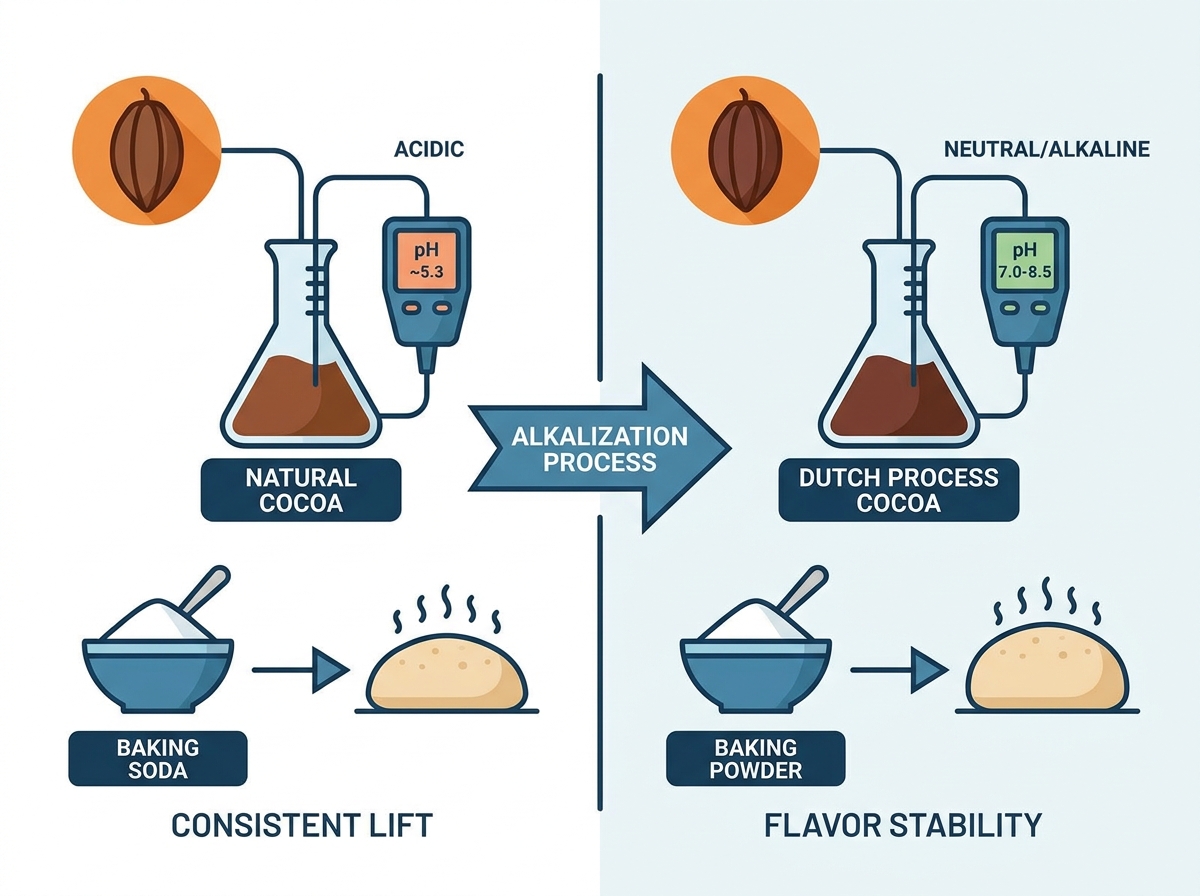
Natural cocoa acts as a highly acidic ingredient. It typically registers a pH level around 5.3. When manufacturers create dutch process cocoa, they wash the raw cocoa nibs in a mild alkaline solution, usually potassium carbonate. This crucial alkalization step raises the pH to a neutral 7.0 or pushes it higher into alkaline territory, sometimes reaching up to 8.5. This pH shift fundamentally changes how the ingredient behaves inside a mixer.
You cannot blindly swap cocoa types without considering your leavening agents. The acidity of your cocoa directly dictates which raising agents will function properly in your batter.
Natural Cocoa Requirements: Because it is acidic, natural cocoa requires baking soda (an alkaline base) to activate. The resulting chemical reaction creates carbon dioxide bubbles, lifting the batter.
Alkalized Cocoa Requirements: Dutch process variants do not react with baking soda. Because the alkalization process removes the natural acids, you must use baking powder for reliable lift. Baking powder already contains its own powdered acid.
Removing the acidic variable gives your R&D teams a massive advantage. You can standardize leavening formulations across multiple product lines. Whether you produce sponge cakes, extruded cookies, or dry mix packets, a neutral cocoa ensures predictable rising. It also prevents the metallic, soapy aftertastes frequently caused by unreacted baking soda in large batches.
Food scientists and R&D developers prioritize ingredients offering high predictability. Alkalized cocoa outperforms natural variants across several key functional metrics in industrial environments.
Alkalized cocoa absorbs liquid ingredients much more uniformly. This superior hydration prevents dry spots and clumping inside high-shear industrial mixers. You achieve a significantly smoother batter rheology. Consistent batter viscosity translates to precise dosing through automated extrusion nozzles, reducing product waste on the factory floor.
Visual appeal drives consumer purchasing decisions. Alkalization allows food scientists to engineer exact color profiles for specific products.
Standard Alkalization: This process produces warm, rich mahogany tones. These reddish-brown hues are ideal for traditional commercial baking cocoa applications like standard chocolate cakes and muffins.
Extreme Alkalization: Producing heavily alkalized cocoa involves extended processing times and higher alkaline concentrations. This yields a deep, jet-black appearance. Manufacturers rely on it heavily for "Oreo-style" sandwich cookies or dark ice cream inclusions. It delivers intense color without forcing you to declare artificial food dyes on your ingredient label.
Alkalization Level | Typical pH Range | Visual Color Profile | Common Commercial Applications |
|---|---|---|---|
Lightly Alkalized | 6.8 - 7.2 | Warm red-brown | Standard cakes, milk chocolate baked goods |
Medium Alkalized | 7.2 - 7.6 | Dark mahogany | Premium brownies, dark chocolate muffins |
Heavily Alkalized | 7.6 - 8.5 | Dark black/charcoal | Wafer cookies, sandwich cookie shells |
Raw cacao naturally contains sharp, astringent compounds and sour fruit notes. While artisanal chocolatiers might prize these complex flavors, mass-market consumers generally reject them in baked goods. The alkalization process actively strips out these volatile acids. It replaces them with an earthy, robust, and familiar "classic chocolate" flavor profile. This smooth flavor remains stable even after enduring high oven temperatures.
Cocoa butter content drastically impacts both the cost and the physical structure of your finished goods. Selecting the correct fat percentage requires balancing economic realities against desired mouthfeel.
Formulators utilize low fat cocoa powder primarily for its structural benefits in delicate applications.
Application: Sponges, meringues, macarons, and dry baking mixes.
Business Outcome: Lower fat content prevents the heavy cocoa butter from weighing down delicate crumb structures. It maximizes oven lift. Furthermore, it is highly cost-effective for high-volume operations. In these recipes, you typically introduce moisture and richness via cheaper, standardized fats like canola oil or commercial shortening.
Higher fat powders act as premium ingredients, offering distinct sensory advantages for specific product categories.
Application: Premium brownies, dense truffles, and rich, heavy batters.
Business Outcome: The extra cocoa butter delivers superior mouthfeel and significantly delays product staling. However, it presents a much higher cost-per-kilo. It also requires rigorous temperature control during warehouse storage to prevent fat bloom—a white, dusty appearance caused by migrating cocoa butter crystals.
You should evaluate the cost-to-performance ratio based strictly on your end-product's required moisture retention. If your shelf-life expectation spans six months on a grocery shelf, a low-fat powder combined with a stable commercial oil often yields better structural longevity than relying on expensive high-fat cocoa.
Transitioning your supply chain to a new cocoa specification carries inherent technical risks. R&D departments must execute careful pilot runs to avoid costly factory-level failures.
Dropping a Dutch-processed ingredient into a legacy recipe engineered for natural cocoa represents a massive risk. Doing so will result in dense, sunken, and unappealing products. The lack of acidity means your existing baking soda will not activate. You must aggressively swap or supplement your baking soda with a double-acting baking powder to restore the lost leavening power.
Alkalized powders typically absorb more water than their natural counterparts. Their modified cellular structure acts somewhat like a sponge. R&D must carefully adjust liquid ratios. You will likely need to increase water, milk, or liquid egg content by a few percentage points to prevent the finished goods from drying out too quickly during their shelf life.
Cocoa powder behaves as a highly hygroscopic material, meaning it eagerly pulls moisture directly from the air.
Maintain strict humidity controls in bulk silos and warehouses.
Keep relative humidity (RH) below 60%.
Control ambient temperatures between 15°C and 20°C.
Failure to manage these environmental factors leads to severe clumping before the powder ever reaches the mixer. More dangerously, excess moisture invites microbial growth, compromising food safety protocols.
Sourcing commercial ingredients requires looking far beyond the initial price per ton. An unreliable alkalized cocoa powder supplier for baking will cost you substantially more in rejected batches and production downtime.
You must demand comparative Certificates of Analysis (CoA) across multiple past shipments. Do not accept a single sample CoA as proof of quality. Look for incredibly tight tolerances in three areas:
pH Variance: Fluctuation should remain within 0.2 points.
Fat Content: Ensure it consistently hits the specified 10-12% or 20-22% mark.
Color Metrics: Verify color consistency using standardized Hunter L, a, b colorimeter values, rather than subjective visual checks.
Global food safety standards leave no room for error regarding agricultural byproducts.
Heavy Metal Protocols: Demand transparent testing documentation for Cadmium and Lead. The supplier must prove compliance with stringent EU regulations and California Proposition 65 thresholds.
Safety Certifications: Only engage with vendors holding active GFSI-recognized certifications. Acceptable frameworks include SQF, BRC, or FSSC 22000.
Evaluate the supplier’s Minimum Order Quantities (MOQs) carefully. Compare these requirements against their proven ability to guarantee long-term price locks. The raw cocoa commodity market experiences extreme volatility. A strong partner will offer hedging strategies and uninterrupted supply chains even during poor harvest seasons.
The ideal vendor understands the complexities of commercial scale-up. They should readily offer pilot-scale samples ranging from 1kg to 5kg for your R&D trial runs. Never commit to pallet-level or container-level purchases before verifying the ingredient's performance in your specific ovens.
Upgrading to alkalized cocoa is a strategic operational decision that standardizes production, improves visual appeal, and stabilizes leavening dynamics. It shifts your manufacturing process from reactive troubleshooting to proactive consistency.
To implement this successfully, consider the following actionable steps:
Audit your current production lines to identify where natural cocoa causes inconsistency in product volume or color.
Request detailed technical specification sheets from vendors, specifically targeting 10-12% fat and heavily alkalized variants.
Initiate small-batch testing to recalculate hydration needs and adjust leavening agents accurately.
Demand historical CoAs from potential suppliers to verify their batch-to-batch reliability over a six-month period.
A: By weight, yes, but not chemically. You must adjust your leavening agents—typically replacing baking soda with baking powder—to account for the neutralized pH.
A: Yes. The process reduces the total antioxidant (flavanol) content compared to natural cocoa. However, in commercial baking, structural stability and flavor typically take precedence over raw nutritional density.
A: Variations usually stem from differences in the raw cocoa bean blend (origin) or slight fluctuations in the alkalization time/temperature. Partnering with a supplier that strictly controls their bean sourcing and processing parameters minimizes this risk.

