



Views: 0 Author: Site Editor Publish Time: 2026-07-02 Origin: Site


Transitioning from small-scale sourcing to commercial procurement transforms how you manage raw materials. In food manufacturing, cocoa powder is not just a flavor profile. It serves as a highly functional ingredient where lot-to-lot consistency, pH stability, and lipid content dictate your final product's success.
Making a poor supplier choice often carries steep consequences. You might face sudden supply chain disruptions, catastrophic formulation failures, or wildly inconsistent color and taste profiles. These formulation errors directly jeopardize brand reputation and operational efficiency.
This guide helps you navigate these complexities by filtering suppliers based on verifiable commercial capabilities. You will learn how to evaluate compliance records, technical support teams, and supply chain resilience. We also review key vendor archetypes to help you secure the ideal manufacturing partner.
Selecting a bulk cocoa powder manufacturer for food requires evaluating supply chain resilience just as heavily as product flavor.
Technical specifications (pH levels, fat content) must align precisely with your manufacturing processes (e.g., baking vs. ready-to-drink beverages).
The top suppliers differentiate themselves through rigorous compliance (GFSI, SQF), traceable sourcing, and reliable minimum order quantities (MOQs).
Switching suppliers requires a structured pilot phase, starting with Certificates of Analysis (COAs) and bench testing.
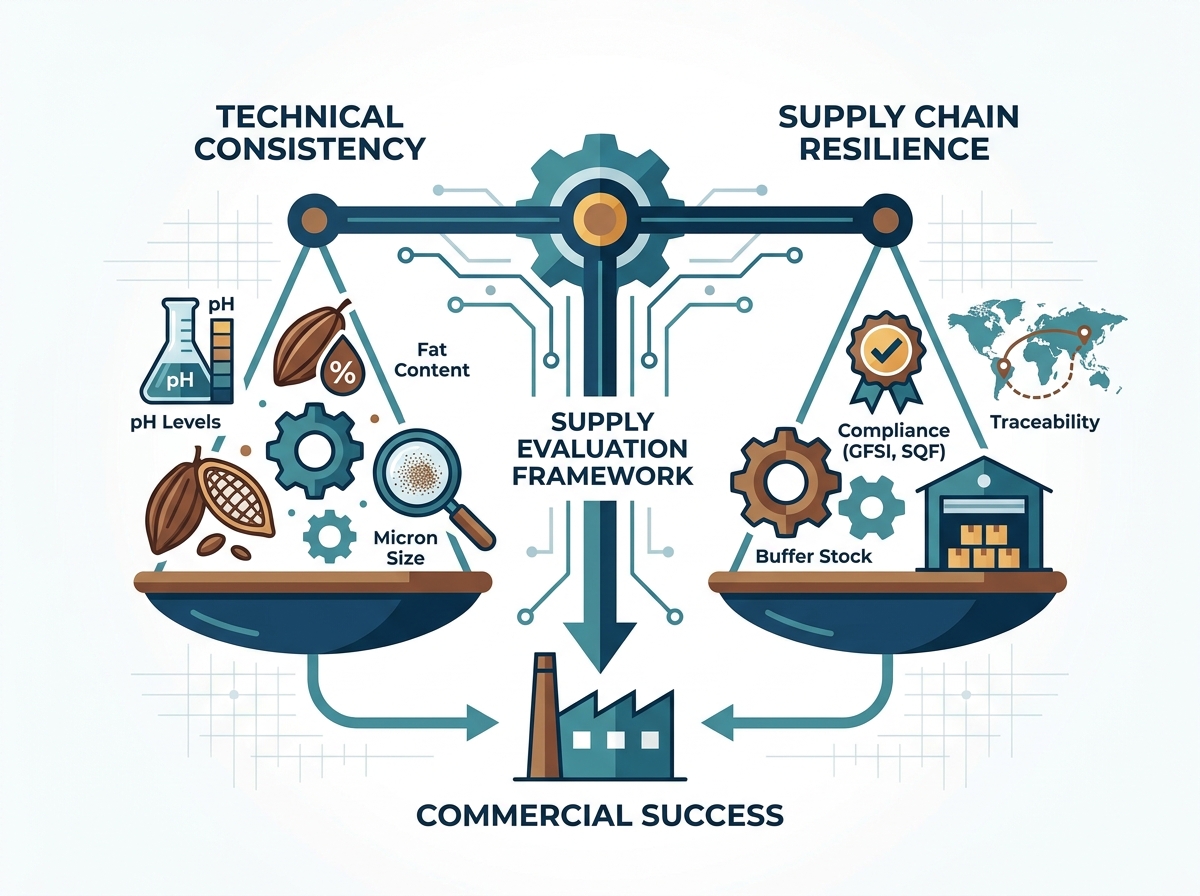
Establishing a strict evaluation framework protects your production lines. We vet potential partners based on three core pillars: technical consistency, quality assurance, and supply chain resilience. You cannot rely on marketing claims alone. A rigorous auditing process ensures they can meet your exact commercial demands.
Technical consistency stands as a non-negotiable requirement for commercial scale. You must demand lot-to-lot reliability in fat content. Standard powders hover around 10-12% fat. High-fat varieties reach 22-24%. If these lipid profiles fluctuate between deliveries, your bakery products will suffer from structural failures. Fineness, measured in micron size, also matters immensely. Inconsistent particle sizes cause grittiness in dairy beverages and prevent proper suspension in liquid applications.
Quality assurance and compliance form the baseline of any serious partnership. Mandatory certifications include GFSI, SQF, and BRC. These frameworks verify proper food safety protocols. Furthermore, routine heavy metal testing guarantees consumer safety. Microbiological testing ensures pathogens like Salmonella never enter your facility. You must require up-to-date documentation for every single batch delivered to your receiving docks.
Evaluating supply chain resilience protects you against global shortages. You must assess a supplier's warehouse footprint. Do they maintain adequate buffer stock? If a shipping container gets delayed, they need local inventory to fulfill your orders. Raw material sourcing transparency also plays a massive role. Certifications like Fairtrade and Rainforest Alliance prove they manage ethical, stable origin programs. This transparency shields your brand from public relations disasters regarding unethical labor practices.
The following breakdown highlights five dominant supplier archetypes in the commercial space. We formatted this analysis using a standardized evaluation structure to ensure objective comparison.
Supplier 1: GlobalAgri Industrial Cocoa
Core Capabilities: Massive production volume, sourcing primarily from West Africa.
Specialty: High-volume conventional cocoa powder.
Best Fit For: Large-scale industrial bakeries and value-brand manufacturers.
Implementation Risk/Limitation: They enforce very high MOQs and offer limited support for niche formulations.
Supplier 2: DutchBlend Pro Processing
Core Capabilities: State-of-the-art alkalization facilities, rapid domestic lead times.
Specialty: Highly specialized alkalization processes and custom pH balancing.
Best Fit For: Mid-market bakeries, confectioners, and beverage brands requiring precise solubility.
Implementation Risk/Limitation: They often charge premium pricing and require strict annual contracting terms.
Supplier 3: OriginCraft Cocoa Partners
Core Capabilities: Custom blending facilities, dedicated technical support teams.
Specialty: premium cocoa ingredients and fully traceable single-origin programs.
Best Fit For: Clean-label or high-end consumer packaged goods (CPG) brands.
Implementation Risk/Limitation: They struggle with scalability if your order volumes spike unexpectedly.
Supplier 4: BulkCom Commodity Trade
Core Capabilities: Extensive global distribution network, maximum cost-efficiency.
Specialty: Standardized commodity cocoa designed for massive global scale.
Best Fit For: Value-brand formulations prioritizing margin optimization over complex flavor notes.
Implementation Risk/Limitation: They offer far less flexibility if you require custom pH ranges or unique color profiles.
Supplier 5: NoirCacao Specialty Ingredients
Core Capabilities: Production agility, specialized proprietary roasting equipment.
Specialty: Unique color profiles and low-fat specialty options.
Best Fit For: Specialty food manufacturers requiring distinct visual appeal in sandwich cookies or dark cakes.
Implementation Risk/Limitation: Their niche focus frequently results in longer lead times for standard commodity powders.
To help you visualize these differences quickly, we compiled a comparison chart summarizing their operational strengths.
Supplier Archetype | Primary Specialty | Ideal Manufacturing Fit | Primary Limitation |
|---|---|---|---|
GlobalAgri Industrial | High-volume conventional | Large-scale industrial use | Strict, high MOQs |
DutchBlend Pro | Specialized alkalization | Confectioners & Beverage | Premium pricing models |
OriginCraft Partners | Traceable origin programs | Clean-label CPG brands | Scalability constraints |
BulkCom Trade | Standardized commodity | Value-brand optimization | No custom pH flexibility |
NoirCacao Specialty | Unique color profiles | Specialty visual appeal | Longer standard lead times |
You must understand the chemical realities of your ingredients before finalizing a purchase. Natural cocoa acts as an acidic component. It generally registers a pH level between 5.3 and 5.8. Because of this acidity, natural cocoa reacts aggressively when combined with baking soda. This reaction creates necessary carbon dioxide for leavening. Conversely, dutch processed cocoa undergoes an alkalization treatment. This bath neutralizes the acidity, bringing the pH closer to 7.0 or higher. Alkalization dramatically improves overall solubility, making it ideal for smooth beverages and dairy applications.
Color optimization represents another crucial technical specification. Consumers eat with their eyes first. You can harness dark cocoa powder to provide a rich, premium aesthetic to baked goods. For dramatic visual impact, you should specify heavily alkalized black cocoa. This intensely processed powder delivers the iconic dark hue seen in popular sandwich cookies. It allows you to achieve stunning visual contrast without relying on artificial food dyes.
Application-specific metrics ultimately govern which specification sheet you approve. Different production lines require entirely different physical properties.
Baking Applications: You must focus heavily on the fat content and lipid profile. The cocoa butter remaining in the powder directly influences moisture retention. Standardizing this metric ensures proper crumb structure and prevents cakes from drying out prematurely on retail shelves.
Beverages & Dairy Applications: You must prioritize solubility, suspension, and fineness. Large micron sizes will sink to the bottom of a ready-to-drink bottle. Poorly alkalized powder will create an unpleasant, gritty mouthfeel in chocolate milk or protein shakes.
Confectionery Applications: You need strict control over flavor volatility. High-heat processing during extraction can strip delicate flavor notes. You should demand flavor retention data if you produce premium truffles or compound coatings.
Commodity volatility constantly threatens food manufacturing margins. The global cocoa market experiences wild fluctuations driven by unpredictable weather impacts in West Africa and South America. Geopolitical factors, export tariffs, and labor disputes further complicate price stability. You cannot simply expect flat pricing year over year.
You must implement proactive mitigation strategies. Work closely with your supply partners to lock in forward contracts. These agreements secure your pricing for 6 to 12 months, shielding your margins from sudden market spikes. You should also demand they hold dedicated buffer inventory locally. Establishing secondary or backup sourcing protocols prevents production line shutdowns if your primary vendor faces an export embargo.
Shelf-life and storage integration require strict operational discipline. Storing bulk pallets introduces technical realities you must manage. Cocoa powder acts as a hygroscopic material, meaning it eagerly absorbs moisture from the air. Poor warehouse conditions lead to massive clumping and premature fat bloom.
Supply Chain Risk Factor | Primary Consequence | Commercial Mitigation Strategy |
|---|---|---|
Commodity Market Spikes | Eroded profit margins | Execute 12-month forward contracts |
Origin Port Delays | Production line shutdowns | Require domestic buffer inventory |
High Warehouse Humidity | Severe product clumping | Install strict climate controls (<60% RH) |
Temperature Fluctuations | Lipid degradation (Fat Bloom) | Maintain strict 15°C - 20°C ambient storage |
Switching your primary ingredient source involves substantial operational risk. You must structure this transition systematically to avoid formulation failures. Never rush a supplier onboarding process just to capture marginal cost savings.
Begin by requesting comprehensive documentation. You need up-to-date Certificates of Analysis (COAs), detailed allergen statements, and verifiable organic or fair-trade certificates. Do not rely on slick marketing brochures or verbal promises. The COA provides the actual chemical blueprint of the product you will receive.
Next, initiate the sampling protocol. You must conduct rigorous bench testing in your R&D lab. Take the new sample and compare it directly against your current control ingredient. Evaluate the powder for dry color, hydrated color, aroma, and basic flavor profile. More importantly, observe its behavior in your specific formulation environment. How does it hydrate? Does it alter the batter viscosity?
Finally, mandate a pilot production run. We strongly advise running a small-scale pilot batch before signing binding annual contracts. You need to observe how the cocoa performs under intense commercial stress. Mixers, industrial ovens, and high-pressure extruders behave differently than a laboratory stand mixer. A successful pilot run confirms the new powder can withstand your actual manufacturing parameters.
Securing the ideal ingredient partner requires deep due diligence and technical foresight. The best supplier marries precise technical specifications with robust supply chain reliability. They provide exact pH matching while simultaneously guaranteeing steady deliveries despite volatile commodity markets.
You now have the framework needed to make an informed procurement decision. Audit your current formulation needs. Identify your non-negotiable metrics regarding lipid profiles and micron sizes. Then, reach out to your shortlisted vendors to request fresh samples and formal COAs. Taking these structured actions will protect your product quality and optimize your operational efficiency.
A: Typical minimum order quantities (MOQs) range from a single 500-kilogram pallet to full truckloads. Your choice heavily impacts pricing. Smaller MOQs suit niche producers but carry a premium per kilogram. Massive industrial facilities order by the truckload to lock in volume discounts. You must evaluate your warehouse capacity before committing.
A: You cannot swap them one-for-one. Natural cocoa is highly acidic and requires baking soda to activate leavening. Dutch processed cocoa has a neutral pH. When making this switch, you must replace baking soda with baking powder. You should run bench tests to ensure the final crumb structure meets your standards.
A: Commercial bulk cocoa powder typically lasts 12 to 24 months. Proper storage dictates this lifespan. You must keep pallets in climate-controlled warehouses. Ideal temperatures range between 15°C and 20°C. Relative humidity must stay below 60%. These strict controls prevent clumping, microbiological growth, and fat bloom before processing.

