



Views: 0 Author: Site Editor Publish Time: 2026-07-04 Origin: Site


Transitioning from small-scale home baking to commercial food manufacturing introduces complex variables. A seemingly simple ingredient swap can easily disrupt an entire production line. Choosing the wrong cocoa specification carries massive operational risks for growing food brands. You might face inconsistent product color, unexpected leavening failures, or severe supply chain bottlenecks. Relying on home-baking assumptions instead of hard technical data often leads to costly product recalls and wasted batches. R&D professionals need precise data to formulate properly at scale. In this article, we will thoroughly explore the vital differences between standard and heavily alkalized cocoa. You will gain a clear, objective framework to confidently evaluate technical specifications and formulation realities. This guide equips procurement teams to secure the exact ingredient profile your brand demands.
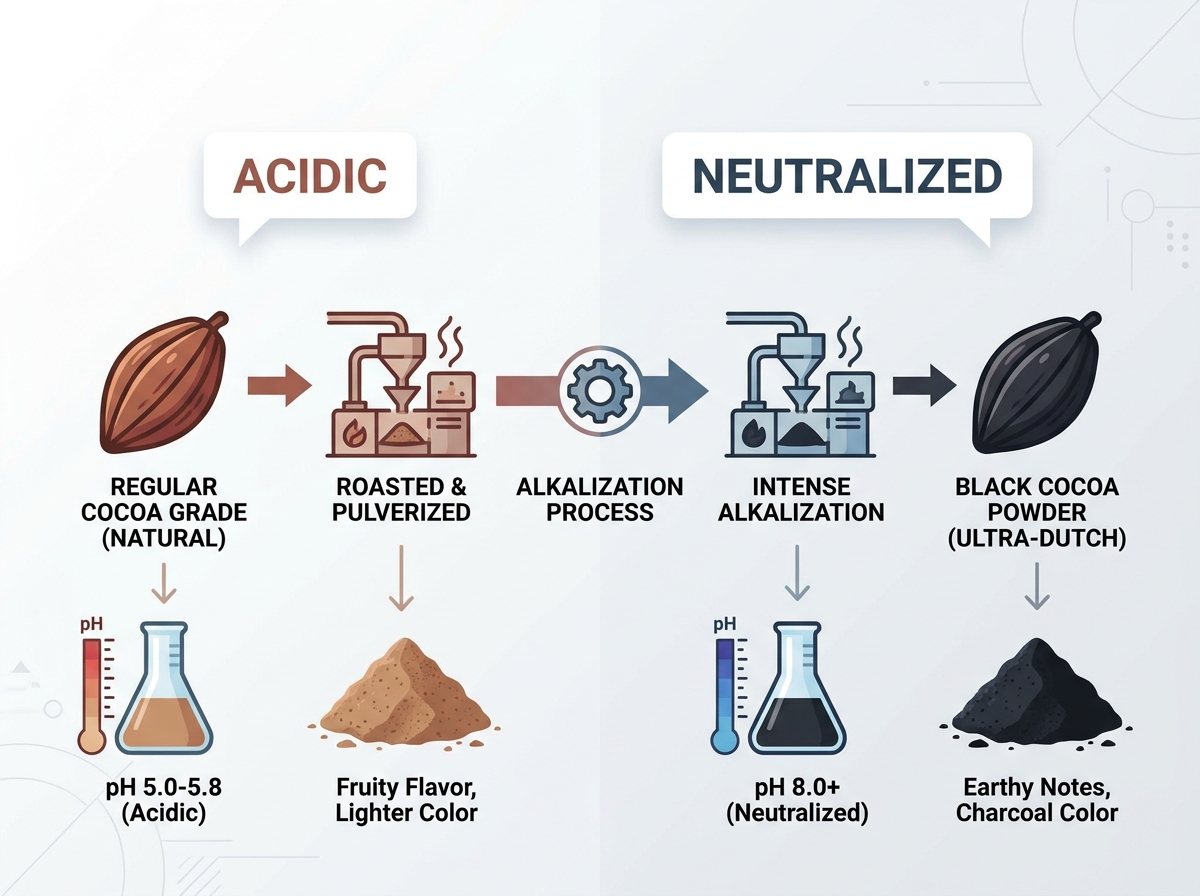
The primary difference lies in the alkalization (Dutching) process: regular natural cocoa is acidic and fruity; black cocoa is heavily neutralized (pH 8.0+) for striking dark color and earthy notes.
Direct 1:1 substitution between regular and black cocoa often leads to leavening failure in baked goods due to altered pH levels.
Selecting a black cocoa powder supplier vs regular grade requires stricter vetting for batch-to-batch color consistency and heavy-metal compliance.
For optimal flavor and color profiles, commercial formulations frequently utilize a blended approach (e.g., 50/50 black and regular Dutch process) rather than 100% black cocoa.
Understanding cocoa powders requires looking closely at their chemical makeup. The manufacturing process dictates how the powder behaves in a commercial formula. Manufacturers classify cocoa based on the degree of alkalization. We often call this the Dutching process. It directly alters the acidity, color, and solubility of the final ingredient.
Processors create natural cocoa by simply roasting and pulverizing cocoa beans. They extract the cocoa butter but do not add any alkaline solutions. This straightforward method preserves the intrinsic properties of the original bean.
Natural cocoa maintains a highly acidic profile. Its pH level typically ranges from 5.0 to 5.8. This high acidity gives the powder a lighter brown appearance. It also delivers a sharp, fruity, and slightly astringent flavor profile. If you buy a regular cocoa grade, you receive a product closely mimicking the natural raw cacao bean.
Dutch process cocoa undergoes a distinct washing phase. Processors wash the cocoa nibs in a potassium carbonate solution. This chemical bath neutralizes the natural acidity. It fundamentally changes how the cocoa interacts with other ingredients.
The pH level of Dutch process cocoa rises significantly. It usually lands between 6.0 and 7.2. This neutralization creates a warmer, darker mahogany tone. The flavor becomes distinctly mellower and more classic. Additionally, the alkaline wash improves solubility. It dissolves much smoother in liquid applications than natural cocoa.
Black cocoa represents the extreme end of the Dutching spectrum. Processors subject the cocoa to intense, prolonged alkalization. They use stronger alkaline solutions and extend the reaction time.
This aggressive processing pushes the pH level to 8.0 or even higher. The physical transformation is dramatic. The powder achieves a striking, charcoal-black color. It effectively acts as a natural colorant for dark baked goods. However, the flavor profile changes entirely. It loses all fruity acidity. You will notice minimal bitterness and a distinct, earthy "sandwich cookie" aroma.
Chemical & Sensory Profile Comparison
Cocoa Grade | Processing Method | pH Level | Primary Color | Dominant Flavor Notes |
|---|---|---|---|---|
Natural (Regular) | Unwashed, purely roasted | 5.0 - 5.8 | Light tan to medium brown | Fruity, sharp, acidic |
Dutch Process | Light/Medium alkaline wash | 6.0 - 7.2 | Warm mahogany brown | Mellow, smooth, classic chocolate |
Ultra-Dutch (Black) | Heavy, prolonged alkaline wash | 8.0+ | Charcoal black | Earthy, flat, "cookies & cream" |
Ingredient specs dictate the final consumer experience. When you switch cocoa grades, you alter the visual identity, flavor depth, and structural integrity of your product. Commercial food formulators must understand these sensory impacts before scaling production.
Visual appeal drives consumer purchasing behavior. Modern shoppers increasingly demand clean-label products. They actively avoid artificial food dyes like FD&C Red 40, Blue 1, and Yellow 5 blends. Heavy alkalization provides a brilliant solution for this industry shift.
Black cocoa acts as a powerful natural colorant. It delivers a jet-black hue without requiring synthetic additives. Manufacturers use it extensively in dark cakes, ice cream inclusions, and premium sandwich cookies. It allows brands to market their products as "all-natural" while maintaining striking visual contrast.
While black cocoa delivers unmatched color, it sacrifices flavor complexity. The intense alkalization process strips away the delicate cocoa butter aromatics. Pure black cocoa yields a surprisingly flat, earthy taste. It does not taste like rich chocolate on its own.
To overcome this, formulators rarely rely solely on extreme ultra-Dutch powders. Instead, they incorporate a quality dark baking cocoa. Mid-range Dutch cocoa retains deeper chocolate notes. It provides the robust cocoa flavor consumers expect. Understanding this flavor compromise is vital for recipe development.
Cocoa powders also vary by their residual cocoa butter content. Suppliers typically offer two main fat specifications. You can purchase low-fat (10-12%) or high-fat (22-24%) powders. The fat content directly impacts product texture.
Low-fat (10-12%) specs: These powders feel drier. They work exceptionally well in extruded snacks and dry baking mixes. The lower fat content prevents clumping and maintains structural integrity in crispy applications.
High-fat (22-24%) specs: Higher fat levels enhance mouthfeel. They deliver a luxurious, creamy texture. Formulators prefer high-fat cocoa for premium ice creams, fudgy brownies, and rich frostings. The extra cocoa butter also improves moisture retention in baked goods.
You cannot simply swap cocoa grades on a production line. Direct substitutions frequently cause catastrophic batch failures. R&D teams must carefully adjust leavening agents, hydration ratios, and ingredient blends to ensure success.
Leavening chemistry is the most common pitfall for emerging food brands. Natural cocoa relies on baking soda to provide lift. Baking soda requires an acidic environment to trigger an acid-base reaction. Natural cocoa provides exactly the right amount of acidity to activate the soda.
Alkalized cocoa changes the rules entirely. Because black cocoa has a neutral or basic pH, it cannot activate baking soda. If you use black cocoa with baking soda, your cake will fall flat. Furthermore, the unreacted baking soda will leave a harsh, soapy aftertaste. You must reformulate your recipe to use baking powder. Baking powder contains its own acid and provides independent leavening regardless of the cocoa's pH.
The Dutching process alters the physical structure of the cocoa particles. Heavily Dutched cocoa becomes more porous and starch-like. It absorbs significantly more liquid than natural cocoa.
If you switch to an ultra-Dutched powder without adjusting your liquids, your dough will become stiff. The final baked product will turn out excessively dry and crumbly. Formulations must adjust hydration ratios. You will need to increase water, milk, or liquid fats to compensate for the higher absorption rate.
Experienced food scientists rarely use 100% black cocoa in premium baked goods. The sensory profile becomes too one-dimensional. They employ a blending strategy to achieve the perfect balance of color and taste.
Identify the primary goal: Determine if your priority is a jet-black color or a robust chocolate flavor.
Select the flavor base: Use a standard dutch process cocoa for 50% to 75% of your total cocoa weight. This provides the classic, mellow chocolate foundation.
Add the colorant: Introduce black cocoa for the remaining 25% to 50%. This darkens the visual profile dramatically without overwhelming the palate with earthy notes.
Adjust leavening: Recalculate your baking powder ratios to account for the blended pH level.
Procurement strategies must shift when purchasing heavily alkalized products. The manufacturing tolerances for ultra-Dutched powders are much tighter. Selecting a black cocoa powder supplier vs regular grade requires rigorous vetting and enhanced quality control protocols.
Color variation ruins brand consistency. For standard natural cocoa, minor color shifts are acceptable. For black cocoa, precision is mandatory. Brands use it specifically for its visual impact.
Procurement teams must demand objective color metrics. The industry standard is the Hunter L, a, b color scale. This system measures lightness, red/green hues, and yellow/blue hues. You must ensure your supplier can maintain tight tolerances on the Hunter scale across different harvest seasons. If they cannot guarantee color matching, your final product will look inconsistent on retail shelves.
Heavy metal compliance presents a major hurdle for cocoa sourcing. Cocoa trees naturally absorb cadmium and lead from volcanic soils. These metals occasionally concentrate differently based on the sourcing region and processing intensity.
The alkalization process can slightly alter how these metals test in final laboratory reports. Suppliers must provide up-to-date Certificates of Analysis (COAs). You need strict compliance with regulations like California's Proposition 65. Furthermore, certifications impact sourcing speed. If your brand requires Fairtrade, Rainforest Alliance, or Organic certifications, expect longer lead times. Certified ultra-Dutched cocoa represents a very small fraction of the global supply chain.
Evaluating supplier scalability prevents future bottlenecks. The intense alkalization required for black cocoa takes specialized equipment. Not all standard cocoa processors have the capacity to produce ultra-Dutched grades at scale.
Assess their minimum order quantities (MOQs). Ensure their production lines can handle your projected annual volumes. You must confirm the supplier’s capacity to maintain consistent alkalization parameters year-round. A supplier might provide a perfect sample, but they must prove they can replicate that exact pH and color across multi-ton commercial deliveries.
Choosing the correct specification requires aligning ingredient chemistry with your marketing goals. No single grade works perfectly for every application. Use this framework to shortcut your R&D process.
Your product demands a fruit-forward, vibrant chocolate profile. Natural cocoa works perfectly when your formulation relies heavily on baking soda for lift. It is also the preferred choice when you need a cost-effective base for standard chocolate profiles. Mass-market brownies, basic chocolate syrups, and standard compound coatings generally utilize natural cocoa.
You need a universally appealing, classic chocolate flavor. Standard Dutching removes harsh acidic notes, making it widely acceptable to general consumers. It provides smooth dispersion in liquids, making it ideal for ready-to-drink beverages and hot chocolate mixes. It also delivers a warm mahogany coloring that looks appetizing in premium pastries.
Your primary objective is purely visual. You want intense dark or black coloring without resorting to artificial food dyes. You should select black cocoa powder if your target flavor profile is specifically the famous "cookies and cream" aesthetic. Finally, ensure your formulation can fully support baking powder leavening and increased hydration before making this choice.
Quick Selection Matrix
Application Need | Recommended Cocoa Grade | Key Reason |
|---|---|---|
Clean-label black coloring | Black (Ultra-Dutch) | Replaces artificial FD&C dyes safely. |
High liquid solubility | Standard Dutch Process | Alkaline wash improves dispersion in water/milk. |
Baking soda leavening | Natural (Regular) | Provides necessary acidic pH to trigger lift. |
"Cookies & Cream" flavor | Black / Dutch Blend | Delivers earthy notes without tasting flat. |
Understand the Chemistry: Recognize that neither grade is inherently "better." Selection is strictly a function of desired visual outcome, flavor target, and pH compatibility.
Formulate for Success: Never attempt a direct 1:1 substitution. Adjust your leavening agents and liquid ratios when transitioning to highly alkalized powders.
Blend for Quality: Combine extreme black cocoa with standard Dutch grades to achieve maximum visual impact while preserving rich flavor profiles.
Demand Strict Specs: Request detailed specification sheets from short-listed suppliers. Target precise pH ranges, fat content percentages, and rigorous heavy-metal microbiological data.
Test at Pilot Scale: Always request pilot-scale samples and run small production batches before committing to massive commercial volumes.
A: No. A direct 1:1 substitution will likely ruin your recipe. Black cocoa lacks the acidity needed to activate baking soda, causing leavening failures. It also absorbs more liquid, making doughs dry and crumbly. We advise starting with a 25-50% replacement alongside standard Dutch cocoa, and switching to baking powder for leavening.
A: Yes, it generally carries a higher premium. The extended alkalization process requires more energy, chemicals, and processing time. Furthermore, global production volumes for ultra-Dutched powders are significantly lower than standard natural cocoa, driving up the baseline market price.
A: The color itself does not cause staling. However, the fat content percentage heavily impacts shelf life. Low-fat (10/12) black cocoa holds less moisture, which can make cakes feel stale faster. Selecting a high-fat (22/24) specification will drastically improve moisture retention and prolong product freshness.

