



Views: 0 Author: Site Editor Publish Time: 2026-07-05 Origin: Site


Selecting the right bulk cocoa partner shapes your entire product identity. A sudden swap in sourcing instantly alters flavor profiles. It disrupts mouthfeel and jeopardizes batch-to-batch consistency. Brands often misjudge procurement by looking only at the price tag. However, true commercial success relies heavily on solubility, precise fat content, stable pH levels, and unshakeable supply chain reliability. If you compromise on these technical factors, your final product will suffer immediately.
We wrote this guide to give you a strong technical and operational framework. You will learn how to evaluate commercial cocoa options thoroughly. We want to help you protect your brand integrity while scaling production securely. We outline exact benchmarks for fat content, alkalization, and particle size. By applying these metrics, you can confidently shortlist partners who meet strict manufacturing demands.
Application dictates specification: Beverage formulations require specific micron sizes and alkalization for solubility, whereas solid chocolate manufacturing prioritizes fat content and flavor intensity.
Technical vetting is non-negotiable: Sourcing genuine premium chocolate ingredients requires rigorous review of Certificates of Analysis (COAs), specifically microbiological limits and heavy metal compliance.
Supply chain resilience matters: A viable wholesale partner must demonstrate lot-to-lot consistency, transparent minimum order quantities (MOQs), and scalable lead times to prevent production bottlenecks.
Success in commercial manufacturing requires strict operational discipline. You must look beyond simple sensory evaluations. A great tasting sample means nothing if the supplier cannot replicate it across ten metric tons. Procurement teams must establish rigid success criteria before requesting a single sample.
Predictability across production runs remains the most critical metric for scaled manufacturing. Lot-to-lot consistency guarantees your product tastes identical in every single batch. Consumers expect a specific experience every time they buy your product. If a new cocoa batch shifts slightly in color or acidity, customers notice immediately.
Natural agricultural variance causes raw cocoa beans to differ by harvest season. High-quality suppliers overcome this challenge through expert blending. They mix beans from different origins to match a standardized flavor and color profile. Always demand detailed spec sheets showing strict variance limits. Consistency will always outperform a fleeting, perfect flavor peak.
Cheaper powders often create a false sense of economy. You must evaluate the true cost of cheaper ingredients closely. Lower-grade powders often lack flavor intensity and color depth. Consequently, formulators must increase the dosing rate to achieve the desired profile.
If you save ten cents per pound but use fifteen percent more powder, you lose money. Higher dosing also disrupts the balance of dry ingredients in your formula. It affects moisture retention and structural integrity in baked goods. Always calculate costs based on the final formula yield, rather than the raw price per pound.
Introducing a new cocoa powder changes the internal chemistry of your product. You must assess how the new ingredient interacts with your current formula base. Cocoa powder reacts differently depending on the moisture, fats, and emulsifiers present.
Stabilizer reactions: Different pH levels can weaken gums and starches.
Emulsion stability: High-fat powders might require adjustments to your lecithin levels.
Base compatibility: Dairy proteins bind differently to cocoa solids than oat or almond bases.
Run thorough stress tests during R&D. Check for rapid sedimentation in liquids. Monitor baked goods for unexpected texture changes. A successful ingredient swap requires zero adjustments to your existing manufacturing steps.
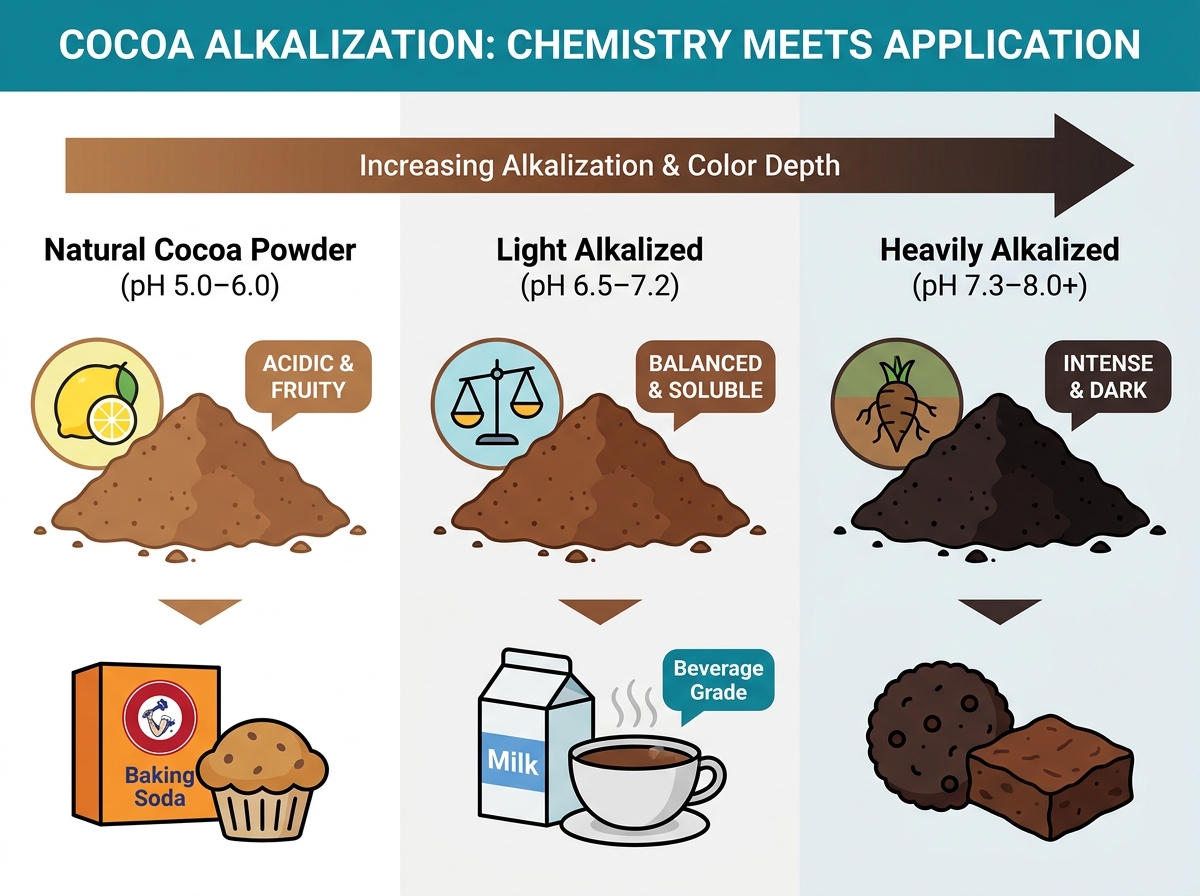
Alkalization, or Dutch-processing, fundamentally changes cocoa chemistry. Processors wash the cocoa nibs in a potassium carbonate solution. This process reduces natural acidity, darkens the color, and alters the flavor profile. Choosing the right pH level dictates your product’s success.
Natural cocoa powder retains its high acidity, typically measuring a pH between 5.0 and 6.0. It delivers sharper, fruitier notes typical of raw cacao. This powder appears lighter in color, often presenting a reddish-brown hue.
It remains the best choice for recipes utilizing baking soda. The natural acids react strongly with baking soda to create lift in baked goods. Formulators also choose it for fruit-forward confectionery items. However, its acidic bite makes it less favorable for smooth dairy applications.
This category sits perfectly in the middle ground. It typically registers a pH between 6.5 and 7.2. The mild alkalization process reduces harsh astringency while darkening the color slightly. You improve overall dispersibility without losing complex, nuanced flavor notes.
Many R&D teams prefer light alkalized cocoa for versatile applications. It performs beautifully in standard baked goods, dry mixes, and compound coatings. It provides a balanced, classic chocolate flavor favored by mass-market consumers.
Heavily alkalized cocoa pushes the pH level between 7.3 and 8.0 or higher. The powder takes on a striking, near-black color and an intensely earthy, woody profile. This extreme processing strips away the fruity, acidic notes entirely.
Bakers rely on it for dark cookies, brownies, and specific visual aesthetics. Think of the iconic dark color of a sandwich cookie. However, the heavy processing diminishes the pure chocolate flavor. Formulators often must blend it with natural cocoa or add flavor extracts to restore depth.
Creating liquid suspensions demands very specific chemistry. Alkalization plays a critical role in preventing rapid sedimentation in ready-to-drink (RTD) applications. Raw cocoa naturally resists water. Treating the cocoa modifies the surface tension of the particles.
Properly processed beverage grade cocoa suspends evenly in liquids. It works flawlessly with carrageenan or other hydrocolloids to keep particles afloat. If you use standard baking cocoa in a beverage, it will sink quickly. This leaves a gritty sludge at the bottom of the bottle, ruining the consumer experience.
Evaluating commercial cocoa requires scientific rigor. You cannot simply trust marketing claims. You must verify actual chemical and physical properties against recognized industry benchmarks.
Cocoa powder is essentially what remains after pressing cocoa butter from the liquor. The remaining fat content drastically changes the powder's behavior and cost. You must match the fat percentage strictly to your application.
Standard (10–12%): This represents the industry baseline. It is ideal for dry mixes, standard baking, and cost-controlled bulk applications. The lower fat content makes it easier to handle in humid environments. It resists clumping in large industrial mixers.
High-Fat (22–24%): This category commands a premium price. The extra cocoa butter delivers superior mouthfeel and a richer, lingering flavor. Formulators consider it crucial for premium ice creams, high-end truffles, and dense dessert syrups. However, it requires careful temperature control during storage to prevent fat melting.
Particle size directly controls texture and solubility. Laboratories measure this via micron analysis. The industry standard tests how much powder passes through a 200-mesh screen. This screen translates to roughly 75 microns.
For standard baking, 99% passing through a 200-mesh screen is acceptable. However, finer powders become mandatory for liquid applications. If you formulate RTD beverages or smooth ice creams, demand 99.5% or higher fineness. Anything less introduces a noticeable, unpleasant grit on the tongue.
You must rigorously verify safety standards before placing an order. Sourcing legitimate food grade cocoa protects your business from costly recalls. Request an updated Certificate of Analysis (COA) for every single batch.
Pay close attention to microbial testing limits. The COA must show negative results for Salmonella and E. coli. Mold and yeast counts must remain strictly below industry thresholds. Moisture limits typically must stay below 5% to prevent microbial growth during transit. Furthermore, ensure strict heavy metal compliance. California’s Prop 65 sets aggressive limits for naturally occurring cadmium and lead. Your supplier must provide documentation proving they meet these geographical standards.
Application Focus | Recommended pH Range | Fat Content (%) | Fineness (200-mesh) |
|---|---|---|---|
Standard Baking | 5.0 - 6.0 (Natural) | 10 - 12% | 99.0% minimum |
Dry Beverage Mixes | 6.5 - 7.2 (Light Alk) | 10 - 12% | 99.5% minimum |
Premium Ice Cream | 7.0 - 7.5 (Medium Alk) | 22 - 24% | 99.5% minimum |
Dark Cookies/Wafers | 7.5 - 8.0+ (Heavy Alk) | 10 - 12% | 99.0% minimum |
A brilliant technical specification falls apart if the supplier cannot deliver on time. Evaluating logistics and traceability is just as vital as testing pH levels. You need a resilient pipeline to maintain uninterrupted manufacturing operations.
The origin of the cocoa beans significantly impacts both marketing and supply chain stability. Single-origin powders offer fantastic marketing leverage on consumer packaging. Buyers love the story behind a single estate in Ecuador or Madagascar. However, single-origin sourcing carries much higher harvest-related volatility. A bad weather season can wipe out your entire supply.
Blended powders solve this issue entirely. Large suppliers blend West African beans with South American varieties. This process guarantees flavor stability and volume availability year-round. For enterprise-scale manufacturing, blends provide the safest operational path.
Environmental, Social, and Governance (ESG) criteria increasingly drive consumer purchasing decisions. You must evaluate the commercial value of specific certifications for your brand. Fair Trade, Rainforest Alliance, and Organic certifications command higher wholesale prices.
Before committing, confirm your supplier can support external audits. They must provide unbroken chain-of-custody documentation. If you claim "Organic" on your label, a missing supplier certificate can trigger immediate regulatory fines.
Commercial cocoa powder generally lasts 18 to 24 months under proper conditions. However, improper logistics destroy product quality rapidly. You must assess the supplier’s warehousing and shipping conditions.
Climate control remains absolutely critical. Temperature fluctuations inside shipping containers cause condensation. This moisture absorption leads to hard clumping and mold. High temperatures also trigger fat bloom in 22/24% powders, where cocoa butter melts and recrystallizes unevenly. Always demand standard shelf-life guarantees upon delivery to your facility, ensuring you receive fresh inventory.
Choosing a reliable wholesale cocoa powder supplier for chocolate requires a structured testing phase. Do not rush this process. Implement a phased evaluation to eliminate weak candidates early.
Start by requesting 500-gram samples from multiple candidates. Conduct blind bench trials to remove brand bias. You must test the powder in the exact conditions of your final product.
Color testing: Disperse the powder in water or milk at uniform temperatures. Observe the color in suspension against a pure white background.
Flavor release: Taste the suspension without added sugar first to detect off-notes. Then sweeten it to evaluate how the flavor blooms.
Sedimentation checks: Let the liquid mixtures sit in clear graduated cylinders. Measure the visible sludge at the bottom after 24 and 48 hours.
Never rely purely on a successful physical sample. The documentation proves the supplier operates a professional, compliant facility. Mandate pre-shipment COAs for the exact lot they intend to ship.
Additionally, request comprehensive allergen statements. You must know if the facility processes dairy, nuts, or soy. Review their detailed technical spec sheets to confirm the particle size and microbiological limits align with your internal standards. Do this before committing to any pilot run.
A supplier might provide a perfect lab sample but struggle to deliver bulk freight. Test their operational capacity gradually. Start with a pilot pallet (usually around 2,000 lbs) before committing to full container loads (FCL).
During this pilot phase, assess their administrative responsiveness. Do they adjust smoothly to Minimum Order Quantity (MOQ) tweaks? Do they provide accurate lead-time estimates? A partner failing to deliver a pilot pallet on time will inevitably cause severe production bottlenecks later.
Securing bulk cocoa requires balancing strict chemical specifications with logistical reliability. You must analyze fat content, alkalization levels, and particle fineness alongside supply chain resilience. An excellent formulation means nothing if the raw materials arrive late or fail microbial testing.
Procurement teams should avoid prioritizing immediate cost-savings over long-term consistency. Cheaper powders often increase dosing rates and introduce production variances. Focus instead on verifiable quality and predictable delivery timelines.
Take action today by refining your raw material requirements. Prompt your R&D and procurement teams to contact vetted suppliers. Request an updated technical spec sheet, a recent COA, and a bench-test sample to begin your evaluation process.
A: Beverage grade cocoa features tighter controls on particle size and specific alkalization levels. Processors mill it extremely fine to maximize solubility. This precision minimizes gritty texture and prevents rapid settling in liquid suspensions, unlike standard baking powders.
A: MOQs vary heavily by supplier size. Mid-sized craft operations often accept orders of 50-pound bags. Enterprise-level manufacturing typically requires full pallets (approximately 2,000 pounds) or complete metric tons to secure optimal bulk pricing.
A: Commercial cocoa typically lasts 18 to 24 months. You must store it in a cool, dry place away from strong odors. High-fat powders remain more susceptible to rancidity and fat bloom if the warehouse temperature fluctuates significantly.
A: Inconsistent color stems from natural agricultural variance combined with relaxed alkalization controls at the processing facility. High-quality suppliers actively blend beans from multiple origins. This blending standardizes the final color ranges and ensures a predictable profile.

